
Twenty Investment Lessons of 2008 – I think this was culled from a Seth Klarman Interview
- Things that have never happened before are bound to occur with some regularity.
- When excesses such as lax lending standards become widespread and persist for some time, people are lulled into a false sense of security, creating an even more dangerous situation.
- Nowhere does it say that investors should strive to make every last dollar of potential profit; consideration of risk must never take a backseat to return.
- Risk is not inherent in an investment; it is always relative to the price paid.
- Do not trust financial market risk models.
- Do not accept principal risk while investing short-term cash: the greedy effort to earn a few extra basis points of yield inevitably leads to the incurrence of greater risk, which increases the likelihood of losses and severe illiquidity at precisely the moment when cash is needed to cover expenses, to meet commitments, or to make compelling long-term investments.
- The latest trade of a security creates a dangerous illusion that its market price approximates its true value.
- A broad and flexible investment approach is essential during a crisis.
- You must buy on the way down.
- Financial innovation can be highly dangerous, though almost no one will tell you this.
- Ratings agencies are highly conflicted, unimaginative dupes.
- Be sure that you are well compensated for illiquidity – especially illiquidity without control – because it can create particularly high opportunity costs.
- At equal returns, public investments are generally superior to private investments not only because they are more liquid but also because amidst distress, public markets are more likely than private ones to offer attractive opportunities to average down.
- Beware leverage in all its forms.
- Many LBOs are man-made disasters.
- Financial stocks are particularly risky.
- Having clients with a long-term orientation is crucial.
- When a government official says a problem has been “contained,” pay no attention.
- The government – the ultimate short- term-oriented player – cannot withstand much pain in the economy or the financial markets.
- Almost no one will accept responsibility for his or her role in precipitating a crisis: not leveraged speculators, not willfully blind leaders of financial institutions, and certainly not regulators, government officials, ratings agencies or politicians.
Provenance Unknown
There are those who view their investments as art and those who view their investments as inventory. The former often like their investments to be beautiful. They want to hang them on the wall and admire them. At a 10,000 foot level many of these folks are avid followers of Buffett. They want to buy and hold and just admire the beauty (although of course the reality is that other than a handful of positions Buffett doesn’t actually hold in that manner, but I digress). On the other hand, there are those, like me, who view their investments as inventory. I liken what I do to stocking a grocery store. You have everything from filet mignon to packs of gum. I don’t care what it is as long as it will make me money. Likewise, I don’t subscribe to the view that a smaller position doesn’t move the needle. Many of these positions can be purchased within an hour or two (or less) of work. It’s like the gum or diet coke in a store. Stock it, sell it, wash, rinse and repeat. I’d do that all day long if possible.
More Unknown
The “Availability Cascade” is defined as a self-reinforcing process in which a collective belief gains more and more plausibility through its increasing repetition in public discourse (or “repeat something long enough and it will become true”). It’s a dangerous flaw in our cognitive process, because it can be easily capitalized on by the deceitful and the hucksters. We are their prey and our only defense is to be more critical in our thinking.
The same occurs in our own industry. Take this excerpt from Mark Buchanan’s The Social Atom. “A few years ago, for example, the economics consultancy
Of course, no one wants to admit to being part of the flock. Everyone is looking for “uncorrelated”, perhaps the most overused, least sincere term in our industry. Here’s the thing about being uncorrelated. In order to achieve uncorrelated returns, you must think in an uncorrelated way. Remember, uncorrelated is not the same as negatively correlated. Contrarians provide negatively correlated returns, but fundamentally, they are still driven by the same inputs as consensus thinkers. In order to truly deliver uncorrelated returns, you must derive and process your information differently. While uncorrelated returns are very desirable, because of their many benefits, in order to achieve them, you must be willing to delve into things that, by their very nature, will make you uncomfortable, even frightened. You must be willing to challenge yourself, and your beliefs. And therein lies the reason so few achieve uncorrelated performance and even fewer allocate to it. Confirmation bias is a far more powerful force than the desire to outperform.
Even More Unknown
- Having no FOMO might be the most important investing skill.
- Few things are as valuable in the modern world as a good bullshit detector.
- Most of what people call “conviction” is a willful disregard for new information that might make you change your mind. That’s when beliefs turn dangerous.
- Pessimism always sounds smarter than optimism because optimism sounds like a sales pitch while pessimism sounds like someone trying to help you.
- Napoleon’s definition of a military genius was “The man who can do the average thing when everyone else around him is losing his mind.” It’s the same in business and investing
- As the saying goes, more fiction has been written in Excel than Word
- Risk is what you can’t see, think only happens to other people, aren’t paying attention to, are willfully ignoring, and isn’t in the news. A little surprise usually does more damage than something big that’s been in the news for months.
- No one is thinking about you as much as you are.
- Read fewer forecasts and more history. Study more failures and fewer successes.
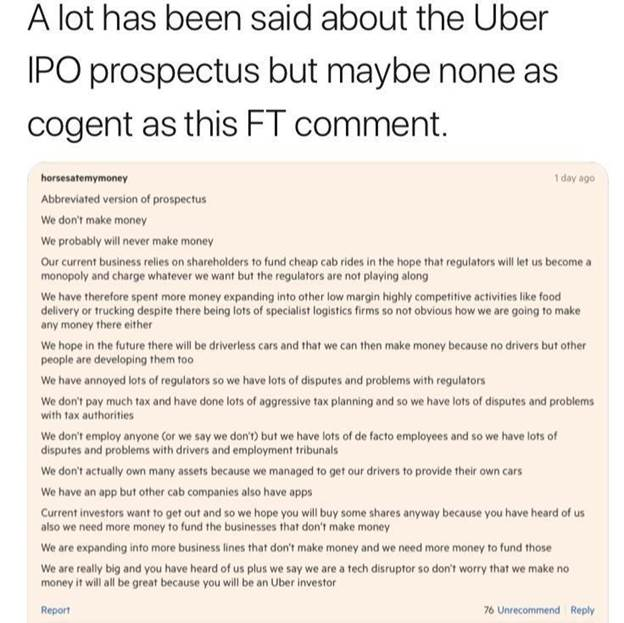
I Enjoy Snarky Financial Commenting as Much as Anyone, but FYI – UBER did North of $9 Billion in Free Cash Flow LTM
Byron Wien: Here are some of the lessons I have learned in my first 80 years. I hope to continue to practice them in the next 80.
- Concentrate on finding a big idea that will make an impact on the people you want to influence. The Ten Surprises, which I started doing in 1986, has been a defining product. People all over the world are aware of it and identify me with it. What they seem to like about it is that I put myself at risk by going on record with these events, which I believe are probable and hold myself accountable at year-end. If you want to be successful and live a long, stimulating life, keep yourself at risk intellectually all the time.
- Network intensely. Luck plays a big role in life, and there is no better way to increase your luck than by knowing as many people as possible. Nurture your network by sending articles, books and emails to people to show you’re thinking about them. Write op-eds and thought pieces for major publications. Organize discussion groups to bring your thoughtful friends together.
- When you meet someone new, treat that person as a friend. Assume he or she is a winner and will become a positive force in your life. Most people wait for others to prove their value. Give them the benefit of the doubt from the start. Occasionally you will be disappointed, but your network will broaden rapidly if you follow this path.
- Read all the time. Don’t just do it because you’re curious about something; read actively. Have a point of view before you start a book or article and see if what you think is confirmed or refuted by the author. If you do that, you will read faster and comprehend more.
- Get enough sleep. Seven hours will do until you’re sixty, eight from sixty to seventy, nine thereafter, which might include eight hours at night and a one-hour afternoon nap.
- Evolve. Try to think of your life in phases so you can avoid burnout. Do the numbers crunching in the early phase of your career. Try developing concepts later on. Stay at risk throughout the process.
- Travel extensively. Try to get everywhere before you wear out. Attempt to meet interesting local people where you travel and keep in contact with them throughout your life. See them when you return to a place.
- When meeting someone new, try to find out what formative experience occurred in their lives before they were seventeen. It is my belief that some important event in everyone’s youth has an influence on everything that occurs afterwards.
- On philanthropy, my approach is to try to relieve pain rather than spread joy. Music, theatre and art museums have many affluent supporters, give the best parties and can add to your social luster in a community. They don’t need you. Social service, hospitals and educational institutions can make the world a better place and help the disadvantaged make their way toward the American dream.
- Younger people are naturally insecure and tend to overplay their accomplishments. Most people don’t become comfortable with who they are until they’re in their 40’s. By that time, they can underplay their achievements and become a nicer, more likeable person. Try to get to that point as soon as you can.
- Take the time to give those who work for you a pat on the back when they do good work. Most people are so focused on the next challenge that they fail to thank the people who support them. It is important to do this. It motivates and inspires people and encourages them to perform at a higher level.
- When someone extends a kindness to you, write them a handwritten note, not an e-mail. Handwritten notes make an impact and are not quickly forgotten.
- At the beginning of every year, think of ways you can do your job better than you have ever done it before. Write them down and look at what you have set out for yourself when the year is over.
- The hard way is always the right way. Never take shortcuts, except when driving home from the Hamptons. Shortcuts can be construed as sloppiness, a career killer.
- Don’t try to be better than your competitors; try to be different. There is always going to be someone smarter than you, but there may not be someone who is more imaginative.
- When seeking a career as you come out of school or making a job change, always take the job that looks like it will be the most enjoyable. If it pays the most, you’re lucky. If it doesn’t, take it anyway. I took a severe pay cut to take each of the two best jobs I’ve ever had, and they both turned out to be exceptionally rewarding financially.
- There is a perfect job out there for everyone. Most people never find it. Keep looking. The goal of life is to be a happy person and the right job is essential to that.
- When your children are grown or if you have no children, always find someone younger to mentor. It is very satisfying to help someone steer through life’s obstacles, and you’ll be surprised at how much you will learn in the process.
- Every year, try doing something you have never done before that is totally out of your comfort zone. It could be running a marathon, attending a conference that interests you on an off-beat subject that will be populated by people very different from your usual circle of associates and friends or traveling to an obscure destination alone. This will add to the essential process of self-discovery.
- Never retire. If you work forever, you can live forever. I know there is an abundance of biological evidence against this theory, but I’m going with it anyway.
