
I tend to find myself reading and ignoring people, and finally I can be diagnosed — Misophonia — a condition where every day sounds seem impossibly aggravating. Or maybe that is just the investment world.
Here in November, I am going with the 1999 theme sans Prince — nothing is more obstinate than a fashionable consensus, until of course “things change” as they seem to improbably do at the time they always do. In the midst of the near impossibility of escaping some breathless conversation about AI or data centers that rarely seem to involve any nearby math, I think it opens up a yawning space for the anti-bubble stocks which can be cobbled together in some reasonably thoughtful fashion and generate the Munger lumpy double-digit returns. That’s what seems to be happening now in this view.
And so, SOME things changed in November, although with a wide aperture lens one might conclude this is simply another mood shift in the vacant middle from “I really don’t like these guys I am voting for, but I hate those other guys more” and to paraphrase the words of Pete Townsend, We Do Get Fooled Again. (Footnote: this was written wearing fatigues and my IDF t-shirt.) A one paragraph guess: the AI-related spend is going to slow under a barrage of political yack, its strength has masked an otherwise sluggish economy and those who benefitted from illusion of 7-year backlogs will not see that benefit any longer, and longer-term interest rates will go down. (And a positive scenario for someone like Google who can take the pedal off the metal?) It’s too early to talk about rapprochement with Iran. And no, you can read elsewhere about the nearly perfect record of stock market advances in the 3rd year of the Presidential regime. We move on the best we can in a world where we are reminded that an awful lot of life lives off-spreadsheet and not in the middle of an AI probabilistic curve.
With Halloween just behind us, a recent headline suggested that “There Was Nowhere to Hide in October.” I might argue the horror movie metaphor: DON’T GO IN THE BASEMENT is not that hard. Huge dollars, huge fees, wonderful new technology and the passage of time with nothing truly awful happening in a financial sense makes systems and people lazy. And lazy is something that can really scale, on its own or metastasize into actual fraud or something really close to it. And giant IPOs of puffery whose risk disclosures invoke Roko’s Basilisk (Thank you again Byrne at The Diff).
It seems like forever ago in the financial news cycle that the world’s acclaimed institutions were throwing billions at Situational Awareness and its 24 year old, whose only experience in managing money was a 165 page paper on AI that was probably 80% written by AI; Jane Street sort of blowing up $15 billion in trading losses to their frenemies at Citadel; Mr. former LA Dodger’s (Still a Dodger hater, but I love the MLB conspiracy theories) disintegrating empire built on private credit and regulatory arbitrage, and the whole system of marks and nods and winks in regard to the public/retail distribution of private and illiquid assets. All that should remain front and center as risk to your financial well-being. To note for the world and arguably the SEC, if you are an investment management holding company of some kind, and your underlying vehicles are public funds, private funds, institutional-only private funds, insurance company portfolios, SPV’s, and your own balance sheet, where is the marginal investment opportunity allocated? Who gets senior priority and who gets the garbage to close the deal?
One of my favorite “anecdotes” of all this stuff is the recent offer by PE Advent International to take private its bastard child and fund stub public holding Definitive Healthcare (DH) for $1.02 per share. This was a Goldman IPO (the same Goldman at the top of the Anthropic masthead) at $27 per share in September 2021 that immediately traded up to $50. The opening enterprise valuation was comfortably 20x revenues. The takeout price is less than 50% OF revenues. And given the lazy and Halloween reference comments, it will likely be unhelpful to general investment market sentiment as many funds and their “3rd party markers” dutifully open up their spreadsheets and use this transaction as a comp. How much of the $400 billion or so (S&P Global Intelligence) software debt incurred to take software private was priced north of 5x revenue vs .5x revenue? And in a deal done with a 10-year note 400 basis points lower?
So yes, this is another way of saying yet again, the world seems very messy, credit plumbing seems ever creakier and the likelihood of “something giving” seems high. It stunk two years ago and it stinks now.
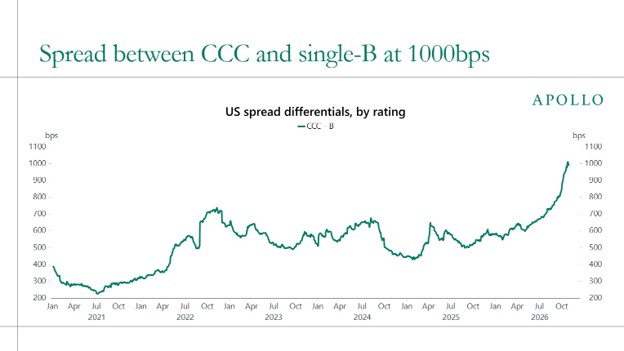
This is a slow-moving mass of mess, and this chart is a suggestion that there is resistance developing toward kicking problematic cans down the road. And yes it matters to you, Mr. “Well, I don’t own any of that stuff.” All asset owners have benefitted from a focus on reward vs risk, and the ability to finance almost anything at any price. And when people with liquidity problems or using leverage need to improve liquidity in a hurry, they sell what they can, not per se what they want. And that tends to be publicly traded assets. Just something to think about. They may be “just marks,” but if you know you know. People don’t like to see negative marks, which if I recall, was one of the big academic constructs of private assets — their value doesn’t move like those nasty public markets.
Here is where we repeat that two macro things that are always worth watching and worrying about are the price and availability of credit and the lean of the Federal Reserve. I don’t know if interest rates will continue to rise, and I just tossed out some not deeply thought-out speculation, but they have gone higher and there is plenty of legacy structure that doesn’t like higher. The Federal Reserve seems to be on a new path to let chips fall where they may, which remains a theory as long as chips aren’t falling. Moving toward something practical, how can one make money if one is so whiny about environmental conditions? The obvious answer is what the hell do I know about macro things, pay attention to individual investments.
Which is what we are here for. Interest rate sensitive stocks are not doing well and thus a new position is Eagle Materials. (EXP: Note all relevant disclosures at CoveStreetCapital.com) This is another position that has been previously owned. But let’s face it, if 40%-ish of your earnings are from being the 5th ranked by size wallboard manufacturer, you ain’t no “compounder” when higher interest rates murder end markets. And being the low cost producer and a user of locally mined gypsum vs synthetic derived from coal is a very good long term thing, it is about as helpful in a rising rate environment that tanks housing demand as being the low cost oil and gas acreage holder when oil prices halve. So, the stock has been whacked which leaves the opportunity. The other half “plus and growing” is cement and aggregates in Texas and the Southeast, and you can go look up definitions of “moat” and apply it here. Management has a history of allocating capital well, which seems like a forgotten blessing as they are about 16 months out from finishing a $1 billion-ish capital expenditure program to add new low cost capacity and retire some older capacity. So, the “stock” reflects a “less share repurchase, more capex spend with returns to come” pricing, that is going to reverse itself in…2027-ish.
Sometimes your inner genius just shows up, and you have a monster winner. It helps. But how you handle problems is important as well. We have “benefitted” this year from some maturity on how truly awful mistakes are handled with the application of long running and grudging acceptance of the concept that “the lowest average cost doesn’t always win.” In other words, let’s say one bought a truly trashed rural cable company with a new and smart management team and lots of free cashflow at what might appear to have been an absurdly low valuation. And let’s say there was an acceptable plan about to be executed to “manage” a very painful piece of leverage inducing acquisition from a deal from previous management. Let’s ignore how dumb this is turning out as an investment and focus on the process, a statement which you should hate hearing as much as I hate saying it. Yes, good process wins over the long-run blah blah, but on my deathbed, I will wish for more “fortuitous circumstances” than a rote formula for success. Said cable investment was risk weighted at “half-position” as applying that weighting to a very wide cone of variability was deemed the proper application of the wisdom and maturity garnered by previous painful experience. Voila, yet another off-spreadsheet event as ONE of the lenders who has very little history of being the a—hole in the liability management room decides to file a lawsuit against the public recapitalization about an hour before deal close on a Friday afternoon. A former self might have bought more…and more, as the lowest average cost wins. Didn’t happen and the beauty of an unleveraged mistake getting smaller and smaller in the portfolio somehow made the original sin shruggable. (Plenty of private self-recrimination.) There were two others that fit this bill, and losing 300bps from being dumb vs 1300bps is what keeps capital compounding and clients retained. (Note to self — make less mistakes.)
This topic closes with a funny and prophetic quote from an interview with OG growth investor Ron Baron, referencing his chat with OG hedge fund “trader” Izzy Englander/Millenium who to be fair declined to hire me at what looked like employee number 12 back in the 80’s.
“So, we’re at this dinner and he’s talking, someone says to him, “So Izzy, what happens if someone falls in love with a stock and they don’t want to sell it?” He says, “Well, when they go to lunch, I sell it, and when they come back, I fire them.” That’s what he does. And so, it’s a whole different strategy.”
So, it remains fiendishly simple, be right, don’t be terribly early, and size appropriately.
We translate this into “Buffetts and Grahams,” the former of which get weighted larger with a slower trigger, and latter of which get appropriately sized and discarded either when reaching target pricing or the realization that wrong is spelled differently than early. We also have a bucket of “gotta guy” stocks where we are actually buying a security under cash value and we think “newco” has a history of putting money to work for shareholders intelligently.
And yes, a client would see exactly what this means in practice and we carefully welcome those.
In closing, we are trying to be judicious in abusing your eyeball time given that we are all drowning in the appearance of thoughtful prose. We seek to find the middle ground between endless commentary on the theme of the day and a 40-page soliloquy on theory or true belly-gazing. I know what I want: give me 4 critical variables and let me peruse on my own.
“Ignoring cycles and extrapolating trends is one of the most dangerous things an investor can do” is so obvious and so ignored that it bears repeating regularly as you contemplate joining what seems like an inevitable career enhancing consensus. Naturally, what is a cycle, what is a secular trend and where are you in those waves is an imprecise science in which to operate. A wonderful business can be an awful stock for a time horizon much longer than the endurance of other people’s capital. And buying “shit that is working” and then flipping on a dime, or an election, is a very hard thing to do, much less successfully.
Think longer term, take advantage of “new tools” to refocus on higher and better use cognitive tasks, read directly, follow the incentives and assume most people fronting public companies are not per se lying to you, but they speak in vested interest. There is a LOT to do out there – Value Restoration Projects await.
Jeffrey Bronchick, CFA
Principal, Portfolio Manager
Cove Street Capital, LLC
